Ola Gedenryd — SPCT, Scaled Agile Affiliated Strategic Advisor for Asia, co-founder of Enterprise Movement · 5 October 2026, revised 7 October 2026
I wrote this with Claude as my co-writer, and a panel of AI reviewers we built challenged every draft. I set the intent and judged what came back. The experience, the opinions and the responsibility are mine.
Agents do the output, people lead on outcomes: that is how we run our whole company, 15 people in eight agentic teams. Our agents produce the accounting we used to buy from an outside firm and most of the work behind our invoicing, marketing and sales; a person approves what leaves our accounts, and a named person every production release. I described how it works in We Run Our Whole Business on AI-Native SAFe.
That article does not say what it takes in a company the size of yours. I have led Lean-Agile transformations in many organizations since 2005 and coached the leaders running them; that work is what my SPCT role rests on. This article is what we commit to when we run it with you, and where our experience stops.
What is left to lead?
Give teams agents and output stops being scarce. Code, plans, test cases, decks: more of it every week, whether or not a customer notices.
The test I use: ask your organization what changed for a customer last quarter. If the answer is a list of what it shipped, it is still managing output. When I put that question to leaders whose teams now work with AI, I usually get that list.
What is left for a leader is the outcome and the few key results that measure it, each written down with a baseline and a date; every team and every agent has to serve them. For a returns process, that could be the days from a customer's request to their refund, with today's figure beside it. Work that serves none of them gets stopped, and stopping work takes a leader's authority. That is the shift Mik Kersten argues for in Output to Outcome (IT Revolution, 2026). In our own company we decide every week, in writing, what to stop and what to keep.
I wrote in the earlier article about unlearning my own job as a producer. Producing was what I was good at, and it was the hardest thing to let go of. In your company, the first person who has to let go of counting output is the executive who funds the work: at every weekly review, they are the one who keeps or stops it.
One ART first
Eight terms I use below:
- Value stream: the people and work delivering one product or service end to end
- ART (Agile Release Train): the team of teams, people with their agents, that runs the value stream
- Outcome tree: the outcomes the value stream is accountable for, and the key results that measure each
- Business owner: the executive accountable for the value stream's business results, who decides what its work is funded for
- PI 0: the period before the first PI Outcome Planning, dated in the offer, in which Design is done
- PI Outcome Planning: the event that opens every planning interval (PI), where the ART plans its work from the outcomes
- Sense & Respond: the weekly review that keeps or stops work against the outcomes
- Phase-out plan: the dated plan of which roles we hold in each PI and which of your people takes each one over, signed in Decide
Scaled Agile published the AI-Native SAFe Implementation Roadmap as the map for this change. I think its phases are right. I just don't walk them as a strict sequence, because a roadmap read that way can turn into months of alignment workshops before any team works differently.
Instead, we start with one value stream and launch your first AI-Native ART in it, so the next ones can copy it. PI 0 is sized to what Design needs, four to six weeks by default. Your leadership team does its alignment work in two days by week 2, then alongside the ART.
What we commit to, step by step
This is the part I would want in writing if I were the one buying. At the end your own people hold every role in the phase-out plan and make the last reading of the key results against the baselines your business owner agreed. Five steps get you there. Weeks count from the start date in the offer.
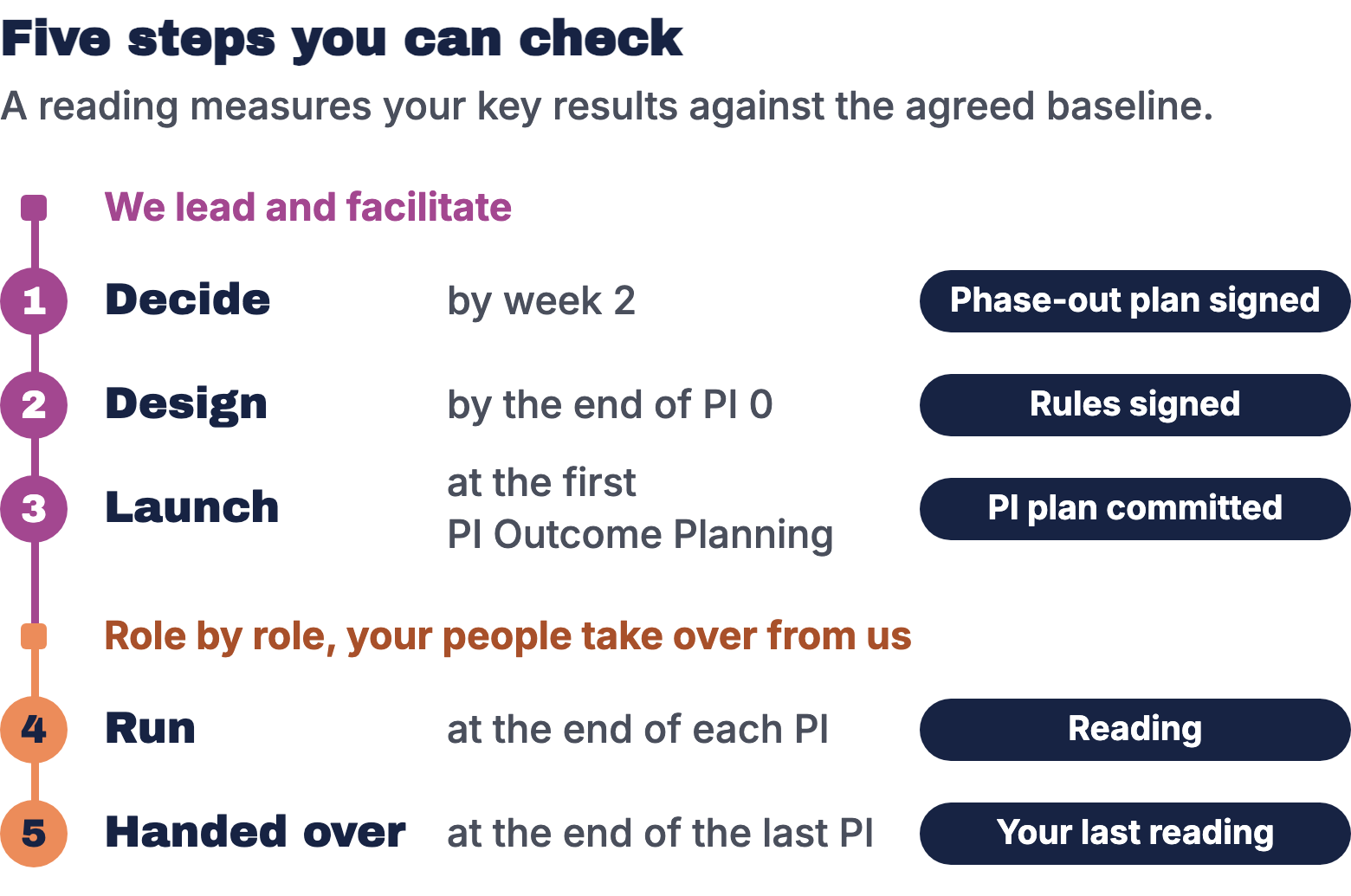
1 · Decide, by week 2
- Your leadership team has completed Leading the AI-Native Organization, a one-day course we deliver, and the Decide workshop.
- The baseline of your organization today is written and dated: where agents do output, if anywhere, what leaders measure, the numbers it reports.
- Your leadership has stated the outcomes for the change, chosen so each can move inside the offer's PIs.
- The value stream where the first ART launches is chosen, with its business owner and its day-to-day owner.
- The phase-out plan names the roles we hold in each PI and who takes each one over, signed by your business owner.
2 · Design, by the end of PI 0
- Everything the first PI Outcome Planning needs: the outcome tree, every key result with a dated baseline your business owner has agreed.
- The teams and their agents are named.
- The ART's leaders have been through Launching AI-Native ARTs, a two-day course, and the cohorts named in the offer are trained.
- The rules for agents are signed by your security team: what each agent may read, change and produce, and which named person approves it.
- Your engineering owner has shown the platform prerequisite working: an agent credential refused at approve, merge and release, and no agent able to read the data your security team bars from prompts.
3 · Launch, at the first PI Outcome Planning
- The event is held, facilitated by us: the PI plan with the outcomes, key results and team objectives, committed by your business owner.
- From that day the ART runs on outcomes; the plan names the output agents do.
4 · Run, at the end of each PI
- The key results are read against the baseline, reported as they stand, with our written advice on what it takes to reach each outcome.
- Every PI Outcome Planning and Sense & Respond has been held, with us in the roles the phase-out plan names for that PI.
- The phase-out steps due that PI are signed off by your business owner.
5 · Handed over, at the end of the last PI
- Every step of the phase-out plan is signed off by your business owner, and every role is held by your own person.
- Your own people make the last reading: the key results against their baselines, each moved toward its outcome, and where agents do the output against the Decide baseline.
By the last PI every key result has moved from its baseline toward its outcome; I will not promise you a figure for how far. What happens if one has not moved at the last reading, or a hand-over slips, is written in your offer, not here.
What it asks of you
- Your leadership team for two days by week 2, the course and the workshop, and its outcomes for the change, stated there
- Your business owner at every PI Outcome Planning and Sense & Respond, signing off each step of the phase-out plan as it falls due
- A named owner who runs the value stream day to day, with protected time for it
- The first ART, working this way as their job, not beside it
- The ART's leaders for two days in PI 0, and the cohort members named in the offer
- The people named in the phase-out plan, taking over each role in the PI it says
- Your security team, signing the rules for agents in PI 0
- A named engineering owner, who confirms the platform prerequisite in writing during the sale; with the Technical foundation, also one person who can grant access without a six-week ticket
What I would not compromise on is your business owner at the weekly Sense & Respond: without them in the room, nobody there can stop anything. None of these asks needs new headcount or a parallel program, or replaces your IT function or your security review.
Before we sign: your leadership's written go, and your security team's and any works council's written decision that agents may work in the value streams under consideration.
How we price it
The standard scope is one fixed price, with no time-and-materials line. It covers:
- Leading: the Decide workshop and the design workshops; every PI Outcome Planning and Sense & Respond, facilitated by us until the phase-out plan hands facilitation to your person, attended by us after that; every reading of the key results, with our written advice
- Training: Leading the AI-Native Organization for your leadership team, Launching AI-Native ARTs for the ART's leaders, and the AI-Native Foundation and AI-Native Value Architect cohorts we design with you during the sale and train in PI 0
- Open availability: your leadership team and the ART's leaders can bring us questions between the scheduled sessions, answered within the offer's consulting days
Operating roles sit outside it. Where the phase-out plan says so, one of our people holds a role in the ART: Release Train Engineer, Product Manager, System Architect or Value Architect. Each role is its own line in the offer, priced per PI, and the plan names the PI in which your person takes it over. None of our roles approves a production release.
Four options, each at its own price:
- Technical foundation. In PI 0, we design the agent platform and build the delivery pipeline in your environment to meet the platform prerequisite, then hand both to your engineering owner. The first PI Outcome Planning is dated after the hand-over. The offer adds it unless your named engineering owner confirms the platform prerequisite in writing during the sale.
- The next ART. Design, Launch, Run and Handed over again for a second value stream, with Decide not repeated.
- Portfolio set-up. The value streams identified, the next ones chosen and put in order, and the portfolio that funds them set up with your leadership team.
- Implementation. A Value in 45 Days engagement on an opportunity from the outcome tree, or our people building alongside the ART, priced per opportunity.
Your own tooling, model and token costs stay with you. The default path is PI 0 and three PIs. The offer fixes the number of PIs (never fewer than two after PI 0), their length and the dates. If a commitment slips, ours or yours, the dates that depend on it move, not the price.
Who this is for
I am writing for two leaders:
- The first owns the budget and the P&L for a portfolio where many teams already work with AI agents: they produce more than ever, and nobody can name the business number that output moved.
- The second has a strategy of productivity through agents doing the work, and wants that work led on outcomes from the first day.
Either way, you need one value stream with a single day-to-day owner, work that repeats every week, and outcomes that can move inside the PIs the offer fixes.
It does not fit if you want the whole enterprise changed at once, or a rollout counted in trains launched and people certified. A team formed around a project that ends is the wrong first choice. If what you want is the framework taught rather than run, our Academy is the right place for that.
What we prove, and where it stops
We are 15 people running our own company this way, on work where a mistake costs us money, and that is the limit of our proof. We have not yet run this with a client, and our results do not predict yours. Your regulation and any works council will shape which value stream goes first. One ART will not make your organization AI-Native; it gives you one that runs this way, in your own people's hands.
Start with one conversation
When your board asks what the AI spend bought, you can show them one ART's key results, read by your own people against the baseline your business owner agreed.
Bring us the value stream you are thinking of, or just the problem. In 30 minutes with people who run our own company this way, we work out whether it fits and what PI 0 would ask of your side. I would rather hear a no in that conversation than after we sign.
Book a free 30-minute consultation →
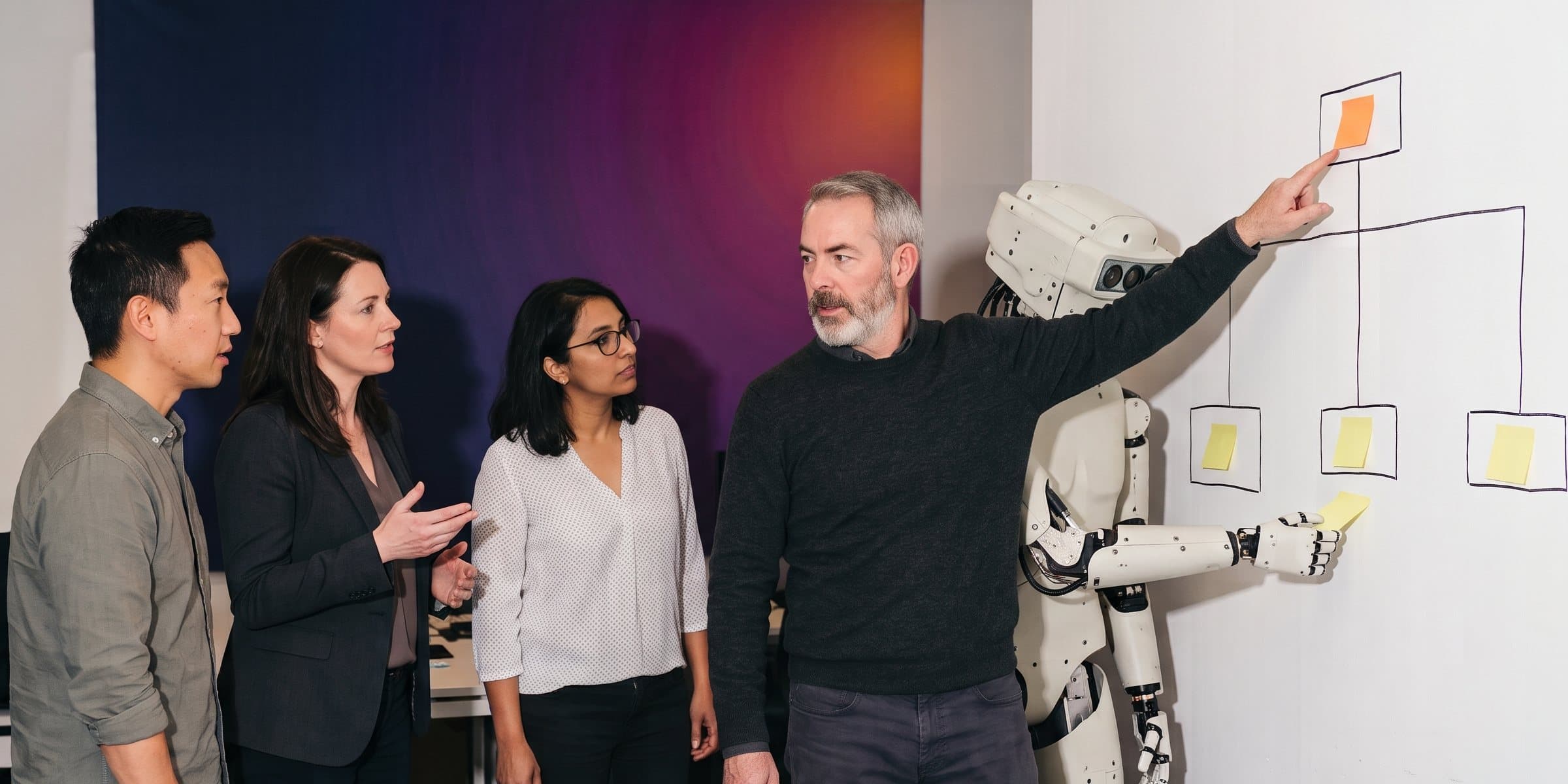
Image: an AI-generated illustration of a team and an AI agent at an outcome tree. SAFe is a registered trademark of Scaled Agile, Inc. Enterprise Movement is an independent consultancy and does not speak for Scaled Agile.