Ola Gedenryd — SPCT, Scaled Agile Affiliated Strategic Advisor for Asia, co-founder of Enterprise Movement · 21 August 2026
I wrote this with Claude as my co-writer, and a panel of AI reviewers we built challenged every draft — the same division of labor this article argues for: I set the intent and judged what came back. The experience, the opinions and the responsibility are mine.
Every enterprise I meet is running AI experiments. Almost none of them can show me the line in the P&L where the experiments pay off. I ask, every time. Somebody in those companies is now being asked why the pilots they funded have not shown up in the numbers. This article is about how to close that gap, on a clock.
The AI chasm
The opportunity is enormous. McKinsey puts the productivity potential of generative AI alone at $2.6 to $4.4 trillion a year, and its State of AI 2025 survey finds 88% of organizations using AI, nearly two-thirds of them not yet scaling it beyond pilots, and only around 6% capturing significant value from it. That distance between trillion-dollar potential and stalled pilots is the AI chasm. I checked both of those sources myself before I started using the figures in front of boards, and I would recommend you do the same.
The models are fine. Most operating models, though, were designed for a world where production was expensive and slow, and nobody has touched them since. Five barriers show up again and again:
- Investments misaligned to business value — AI effort disconnected from strategy, with no success criteria
- Initiatives stuck in pilot mode — proofs of concept with no path to production
- A workforce that isn't activated — skills exist, but workflows never change
- Data that isn't ready — fragmented, inconsistent, untrusted
- No governance or ROI discipline — nothing can scale safely
None of these five is a technology problem. You cannot buy your way past a misaligned operating model, though plenty of companies keep trying.
Drowning in output
A second problem is emerging inside organizations that have already adopted AI, and it is subtler: they are drowning in output.
AI has made production nearly free. More code, more documents, more decks, more campaigns, more tickets, and increasingly agents producing output for other agents to consume, review and summarize. Left unled, this becomes AI slop feeding AI slop: activity charts climb while nothing a customer or a P&L would recognize as value gets created. Volume was never good evidence of progress, and with agents in the mix I would not read anything into it at all.
Production capacity is no longer the bottleneck. What is scarce now is direction. So the leader's job changes. Stop managing output, start leading on outcomes: a few measurable results, tied to your strategy, that every AI initiative has to serve — the human ones and the agentic ones. Skip this and the rest is unmeasurable. You cannot say whether a pilot worked, because nobody wrote down what working means. And that is why so many AI projects overrun: with no agreed number to hit, the scope keeps moving, the deadline goes first, and the budget follows it.
So let me be clear about who I am writing for. If you own a P&L, and your AI pilots keep overrunning their time box and taking the budget with them, and you still cannot answer the simple question of what value actually arrived — then I am writing for you. You want something measurable, inside a fixed window. That is what the 45 days are for.
The 45-day answer
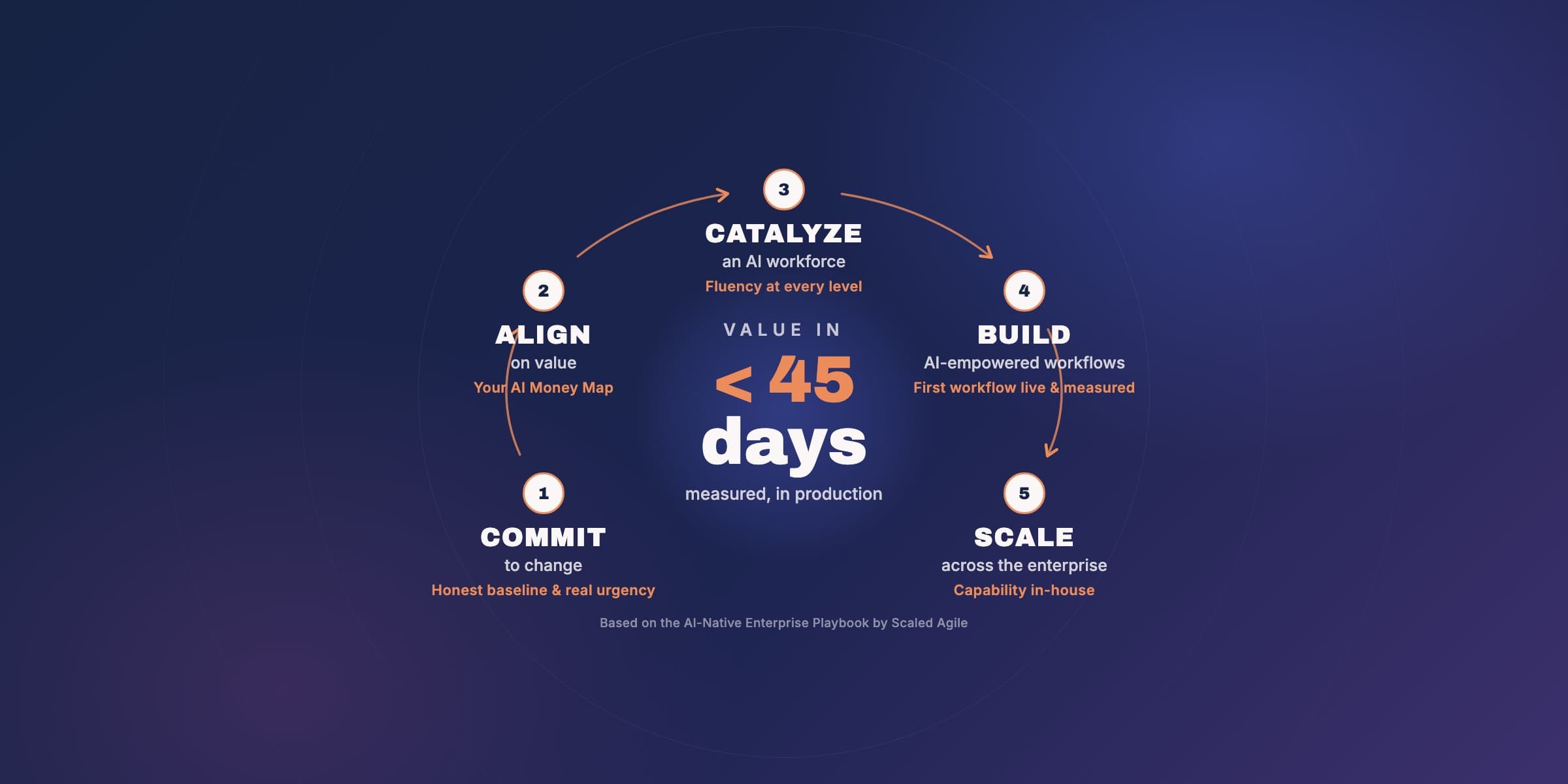
By day 45 you have a working, measured, AI-empowered workflow in production, not a strategy deck. In production means in your production, under your controls: the workflow passes the same security review and data-access rules as anything else you run. The 45 days compress the decision time. They do not touch your control gates. Scaled Agile's AI-Native Enterprise Playbook, the delivery side of the AI-Native SAFe Big Picture, gets there in five phases:
- Commit to change — leadership alignment, genuine urgency, and an honest baseline assessment of where your organization actually stands
- Align on value — strategic intent and an AI Money Map that connects every initiative to a measurable outcome
- Catalyze an AI workforce — fluency at every level, not skills that sit in a silo
- Build AI-empowered workflows — through a repeatable solution lifecycle: discover, design, deliver, measure
- Scale capabilities across the enterprise — with governance in place before the first solution scales
That last phase is where leaders push back, so here is exactly what I mean by it. The day-45 workflow ships under the controls that one workflow needs: named approvers, an audit trail, a way to roll it back. Scale is where those controls become the enterprise standard instead of one team's local arrangement. Putting them in afterwards costs far more, and I have watched organizations pay that bill.
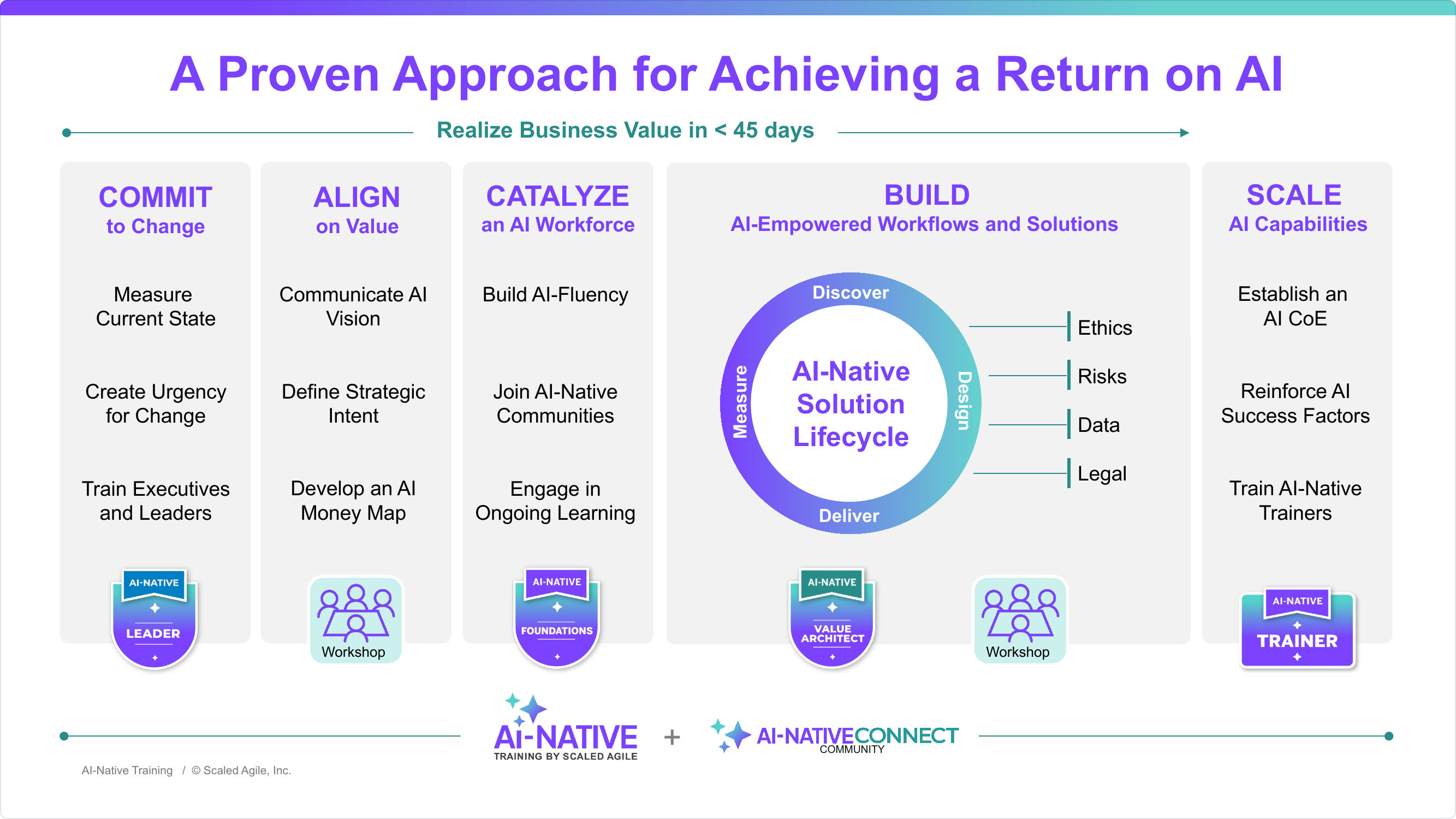
We do not deliver a certificate. We deliver a workflow that runs. The trainings and workshops underneath each phase in the figure are how we get there: Leading the AI-Native Organization for Commit, a workshop for Align, AI-Native Foundation for Catalyze, AI-Native Value Architect plus a workshop for Build, and a train-the-trainer program for Scale, so the capability stays inside your company. The three programs you would meet first are linked further down.
The AI-Native program itself was built from the ground up for this way of working, rather than by adding an AI module to the courses that already existed.
Your leadership team baselines and aligns in the first two weeks, one of your real workflows is rebuilt and shipped by day 45, and the number it must move is agreed before anyone builds anything. When I run Align with a leadership team, the Money Map on the wall at the end of the day is theirs: real workflows with owners attached and the numbers they signed up to move.
We can commit to 45 days because the sequencing does the work. The baseline tells you where it hurts, the value map tells you which bet to make first, and by the time you deliver you have built a lifecycle you can run again. Day 45 itself is inspectable: the workflow is in production and the number agreed in Align has a reading against its baseline. If it has not moved, everyone can see that too. In most AI programs I see, a day like that never comes.
One more thing, about whose workflow this is: yours. Your people lead it, their agents do the output, and we are in the room. We are not a delivery shop that drops a system into your estate and leaves you the maintenance. By day 45 the workflow runs on your side, and the people who will keep it running are the ones who built it.
What it costs on your side, so you can decide today whether it is realistic:
- Your leadership team, two days in the first two weeks — one day of Leading the AI-Native Organization, one day of the Align workshop
- One named owner of the workflow we rebuild — someone who spends real time on it, not someone sponsoring it from a distance
- The people who run that workflow today — plus two days of AI-Native Foundation for the ones who will keep it running afterwards
- One person from your engineering or IT side — someone who can get us the access, the integrations and an environment without a six-week ticket
No new headcount, no parallel program. The engineering contact is the one I would not compromise on. That is the person most often missing when a 45-day window slips. If you cannot free those four, the 45 days will not hold, and I would rather say so in the first conversation than in week five.
And about the data. "Our data is not ready" is the objection I hear most often. Across the enterprise it is usually true. For these 45 days it mostly does not matter. We pick a first workflow whose data is already good enough and curate that slice properly, instead of waiting for a data program to finish. If there is no such slice anywhere in your business, that is worth knowing on day one; then the first 45 days are about creating one.
Picking that workflow is the first real decision, so here is what I look for, and you can make a shortlist before we even talk:
- It runs often enough — its number can move inside the 45 days
- One named person owns it end to end — someone you can put in the room, not a committee
- Its data sits in one or two systems — ones you already control
- Somebody in the business complains about it today — the pain is real and current, not projected
A workflow that fails any of those makes a poor first one, even if it is the one that matters most to you. The ones that matter most are usually our second and third.
Why it holds
None of this is invented from scratch. The playbook sits squarely on the change-management thinking that has shaped transformations for decades. If you know Kotter's eight steps, you will recognize the skeleton: urgency, coalition, vision, short-term wins, instituting change. If you work with Prosci's ADKAR model the mapping is just as direct, from Awareness and Desire in Commit through Knowledge and Ability in Catalyze and Build to Reinforcement in Scale. The 45-day delivery is Kotter's short-term win with a deadline on it. You need one early result people can point at, otherwise nothing after it gets funded.
The pattern behind the successes
I did not have to look far for examples. Morgan Stanley's advisors were sitting on around 100,000 internal research documents nobody could find their way through. Their AI assistant, grounded strictly in that curated internal knowledge, is now used by 98% of advisor teams, and the share of documents an advisor can actually reach went from 20% to 80%. Note what those numbers are about: not fewer advisors, but far more of the firm's knowledge within reach of the ones they have.
IKEA's "Billie" bot could assist 47% of the customers who used it in its first two years, and 74% today. Instead of cutting the roughly 8,500 call-center staff whose work it had partly taken over, IKEA retrained them into customer-resolution (the harder cases the bot cannot close) and remote-sales roles. That human channel now runs 24 centers, and did €1.25 billion last fiscal year.
I keep both cases in my pocket for the same reason. In each one somebody senior stayed on it past the first quarter, and somebody did the boring work of curating the data before anyone touched a model. But the decision I actually point clients at is IKEA keeping the 8,500 people and retraining them. I know where that decision comes from: I worked at IKEA for 18 years and led large initiatives across the company. The thinking behind a decision like that is literally on the wall there. Every IKEA office has Ingvar Kamprad's Testament of a Furniture Dealer up somewhere, and it anchors what is expected of every leader long before anyone hands you a target. Keeping the 8,500 was a leadership decision about what people are for, not an AI decision at all, and it is the one I see most companies get wrong.
The proof I know best is our own. Enterprise Movement itself runs on this playbook: the platform behind our business (accounting, Academy, campaigns, invoicing) is specified, built and shipped AI-natively by 15 people, and new modules go from first specification to production in hours or days. How we run the whole company on it is the subject of the next article. Our clients' numbers are theirs to share, not mine, but I will walk you through the ones I can when we talk.
How the journey is delivered
These are the programs we deliver inside a transformation — most clients meet them as steps in an engagement, not as standalone courses. They are what the 45 days are built from:
- Leading the AI-Native Organization — for executives: the four things only leaders can do, and how to do them
- AI-Native Foundation — for the broad workforce: LLMs, agents, and a first agentic AI built on a real business challenge
- AI-Native Value Architect — for the people who will carry the capability in-house: from pilot success to enterprise-scale impact
You do not have to pick between them today. Which ones you need, and in which order, is one of the things we work out in the first conversation.
We help you get there
At Enterprise Movement, our purpose is Making Lives Better — for People, Organizations, and Society, and closing the AI chasm is that purpose in practice. We were among the first 13 chartered global partners trusted to deliver the AI-Native program, and our consultants run these transformations for a living. And before we asked any client to make this shift, we made it in our own company.
Bring us a real challenge and we will give you a free 30-minute consultation. We will not bring slides, just a working conversation about where your first 45 days of value would come from, and the numbers you should expect from it.