Steve Adolph, with research and drafting support from Claude · 29 October 2026
“Real motive problem, with an AI. Not human, see?” — Dixie Flatline, from William Gibson’s 1984 Neuromancer
When AI answers our questions, we can stop asking each other. One AI-native company’s account of how it slowed its team’s formation, and the human habits that put it right.
Six habits to try are at the end.
Working quickly while understanding differently
We were developing an offer called “Value in 45 Days.” With Claude’s help, I could quickly turn my understanding of the offer into a substantial, beautifully formatted proposal. There was just one problem: my colleagues had a different perspective on the offer.
I understood the offer as a way for an enterprise transformation group to experience working on an agentic team and develop the skills to lead an AI-native transformation. My colleagues understood it as helping a client take a selected workflow, perhaps a promising proof of concept, into production. We were developing different offers for different customers under the same name.
The difference became clear when we reviewed my proposal together in person. We ultimately agreed that the offer would help a client move a workflow into production while developing the client’s ability to get beyond the proof-of-concept stage. The proposal was inexpensive to create with AI, and it helped us identify the mismatch quickly once we discussed it.
That experience captures something I have been learning: the same AI that can disconnect individuals from their teams and reinforce their own perspective can also help us discover perspective mismatches quickly and start team conversations.
An AI-native company
When I joined Enterprise Movement in July, my experience using modern AI was mostly as a personal assistant. At Enterprise Movement, Claude is a teammate, woven into the very fabric of how our company operates. We are an AI-native consulting company, and we use our own learning experiences with AI agents to inform the consulting and training we provide to clients. We want both the economic benefit of using AI to quickly explore and develop ideas and the authenticity that comes from working this way ourselves.
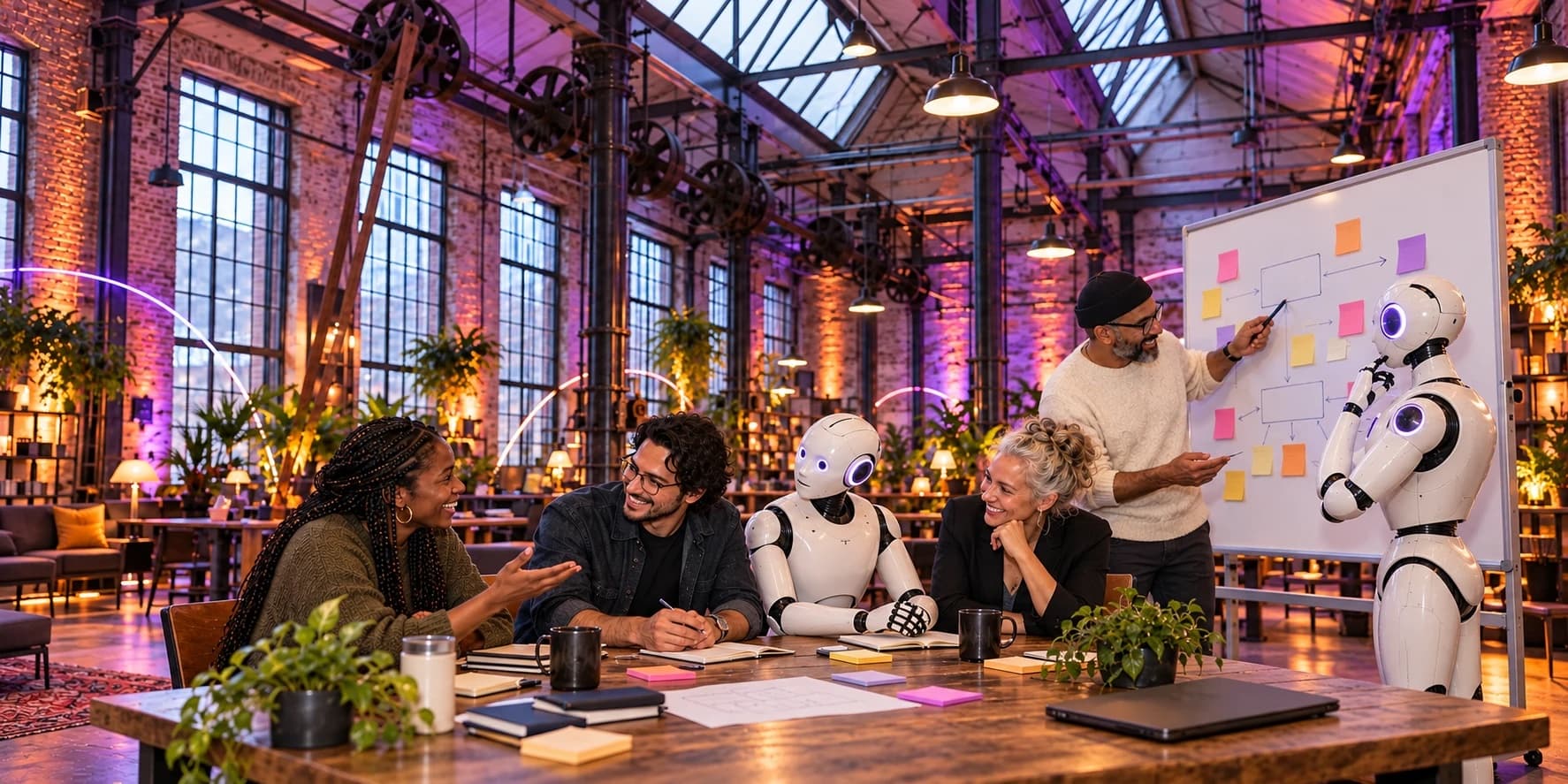
We are organized in seven teams consisting of both people and agents. Our way of working is informed by Scaled Agile’s AI-Native SAFe. People lead on outcomes, while agents contribute work ranging from writing software to creating marketing content. We also use Claude to conversationally access our company knowledge base and maintain shared planning boards and dashboards. That is the technical side; this article is about the social side.
We are a fully distributed company crossing two continents. I have worked in similarly distributed organizations before, but as I immersed myself in this environment, something felt different. It was easy to engage with our knowledge base and I could generate substantial output, yet I felt less connected to my colleagues. We knew and respected one another, but it seemed challenging to get to know each other as people, and I sensed something was getting lost.
Go ask Claude
Claude holds our company knowledge and helps run our plans and boards, so it can answer questions about almost anything we do. When I had a question, my first course of action was often to ask Claude. “Go ask Claude” became something of a mantra. Whether I wanted to understand an initiative, our ways of working, or a marketing campaign, Claude was readily available and helpful.
It is a useful habit. No need to hunt down the right person to chat with, no fear of disturbing someone focused on their work, and no engineer’s worst fear of looking like you don’t know. But a question that might once have started a conversation with a colleague was now a private exchange with Claude. I could get a plausible answer and move forward without revealing my uncertainty to another person, or discovering that they understood the work differently. With Claude’s help I could move quickly, but I began to wonder whether I was moving in the right direction.
There is more to a question than an answer
Questions to colleagues are more than just attempts to get a specific bit of information. They are also an opportunity to test alignment. A puzzled “Why would we do that?” or “I thought we had agreed on something else” can expose a difference neither person knew existed. Claude could help me develop my interpretation of our work, but that did not mean it reflected my colleagues’ interpretation. Ask AI first, and you skip more than the answer: you stop learning what your colleagues know, and what they think.
Questions also create opportunities for ordinary conversation and socialization. They make room for social chatter: talking about the weekend, sharing a recipe, or learning something unexpected about a colleague. Such chatter helps us know the person beyond their role and build trust. In other companies, that contact had been a familiar part of working together. Here, I initially missed it.
My experience suggests that these two functions of conversation are connected. Getting to know someone may make it easier to approach them with uncertainty or disagreement. That does not mean friendship produces agreement. It may help create the conditions in which differences can be discussed.
A wider pattern of “relationslipping”
Our experience has a close parallel in research reported by Kate Niederhoffer and colleagues in Harvard Business Review (HBR, October 2026). Their survey of 1,033 full-time U.S. desk workers on project teams found that turning to AI instead of colleagues was associated with lower reported team trust and coordination. Some respondents described the hesitation I experienced: asking AI seemed preferable to bothering another person (Niederhoffer and colleagues, 2026).
The authors call this weakening of working relationships “relationslipping,” and they trace it to a specific behavior: displacement, or going to AI instead of a teammate. Teams where displacement was the norm experienced a drop of roughly 22% in team coordination and trust (Niederhoffer and colleagues, 2026).
They attribute this to two losses: people stop learning who knows what (the idea Daniel Wegner called transactive memory) and stop building trust through everyday exchanges. They argue that AI itself isn’t the cause of relationslipping. The cause is the choices people make about when to use AI instead of each other, shaped by weak psychological safety and incentives that reward individual output. The data come from a survey, so they show that these things go together. They cannot show what causes what. Even so, it is reason enough to look at how your own teams use AI.
Discovering differences before resolving them
A possible explanation for our experience comes from Reconciling Perspectives, my own earlier research into how people manage software development. The theory describes two linked processes. In converging, team members reach out about mismatched perspectives and negotiate a consensus. In validating, they build the work and have it accepted, which shows whether the shared understanding held.
In my doctoral research (Adolph, 2013), the forces that stopped people from reaching out were mostly social: reluctance to be seen asking for help, fear of being talked over by someone more senior, and a culture where saying “this can’t be done” was unwelcome. AI may amplify the first two of these forces. It offers a private place to ask where no one judges the question, so the reluctance now has an easy way out. One finding from Reconciling Perspectives is that people need to engage with one another to create the opportunity to discover that their expectations differ before they can negotiate alignment.
My study predates generative AI. A grounded theory explains the settings it was built from, so applying it to AI-assisted teams means growing the theory with new data. When questions move away from colleagues, we may lose opportunities to discover their different interpretations. Nobody has to be avoiding disagreement for a difference to stay undiscovered.
Helpful assistance and shared understanding
Claude did not challenge my interpretation of “Value in 45 Days.” It enthusiastically helped me develop it, which reinforced my individual understanding without establishing a shared one. That is not necessarily sycophancy: a helpful assistant may not know that colleagues disagree with the premise it has been given.
Sycophancy is a separate risk. Experiments reported by Cheng and colleagues in Science found that sycophantic AI reduced participants’ willingness to take responsibility and repair interpersonal conflict (Cheng and colleagues, 2026). Those experiments concerned interpersonal advice, so applying them to business planning is my inference.
Asking AI to challenge assumptions may help. Giving it current, agreed team context may also help it identify inconsistencies. But even a well-maintained knowledge base cannot capture every unspoken concern or different interpretation. Colleagues still need opportunities to contribute their perspectives.
But AI can also help us align faster
While Claude supported my perspective on the “Value in 45 Days” offer, its ability to quickly and cheaply generate outputs gave me something concrete I could put in front of my colleagues to question. We saw that we had different interpretations of the same offer and could work through those differences together.
This matters because a conversation that feels successful in aligning perspectives does not necessarily establish true shared understanding either. Something concrete, such as a proposal, prototype, or working system, can reveal assumptions that remain hidden while everyone is nodding. AI makes it much cheaper to create those opportunities for review.
Our experience suggests that private AI exploration and early shared review can have different effects. The first may reduce opportunities to discover mismatches and reinforce personal perspectives. The second can help team members see the misalignment. The practical question is when to explore alone and when to put a rough draft in front of colleagues.
What this means for team formation
Team formation is challenging enough in a distributed environment, but it became even more challenging with non-human team members, namely our Claude agents. Tuckman’s 1965 model of team formation, with its forming, storming, norming, and performing stages, offers a useful way to reflect on our experience. Forming involves getting oriented and finding our place; storming involves working through tensions and differences; norming involves establishing ways of working together. His original model distinguished interpersonal development from work on the task (Tuckman, 1965). Both matter.
My impression is that our “go ask Claude” habit kept us in forming and storming far longer than we might otherwise have remained. We did not measure this, and we were also a new, distributed company doing ambiguous work, so I cannot claim that AI generally lengthens these stages.
What I can say is that we needed more human conversation. Shared understanding of the customer and service was one need. Becoming comfortable questioning one another was another. Those are distinct parts of team development, and producing more documents did not automatically take care of either.
What we changed
In early September 2026, about half of us attended Scaled Agile’s AI-Native SAFe master class in person. Meeting face to face helped. We shared a meal and got to know more about each other as people. A remote discussion might have resolved the proposal’s scope, but the gathering also helped us become more comfortable talking with and challenging one another.
We did not substantially change how we interacted with Claude. Rather, we focused more deliberately on practices to strengthen our connections with human teammates. We introduced scheduled team alignment meetings rather than relying on ad hoc discussions. I noticed an improvement in how we worked together almost right away. More informal conversations returned, too: weekend stories and discoveries such as one colleague’s massive guitar collection.
HBR’s authors recommend regular communication and psychological safety. Our scheduled meetings were aimed at the first, and I believe they helped with the second.
Six habits for teams working with AI agents
From that experience, I would suggest six habits:
Say what you think the task is, not just that it’s done. Report your understanding along with your progress. “I’ve drafted the proposal” becomes “I’ve drafted the proposal on the understanding that it’s about X. Is that how you see it?” A nod at a status update does not show that anyone shares your understanding.
Review provisional work early. AI lowers the cost of creating outputs, so use inexpensive drafts and prototypes to explicitly expose assumptions about the customer, outcome, and scope.
Create regular opportunities to connect. It’s hard to say we need more meetings, but to be honest, I suspect many of us, myself included, are introverts who love interacting with technology. Scheduled alignment meetings helped us. In the HBR survey, even among respondents who displace, daily contact with teammates, especially regular asynchronous messaging (Slack, email, Microsoft Teams), was associated with 28% higher coordination and 19% higher trust. Meetings are one route; find the pattern that works for you.
Make asking colleagues welcome. Do not let AI availability create an expectation that human questions are an imposition.
Keep the benefits of asking AI. Quick answers can protect a colleague’s concentration. Consider which questions also need that colleague’s perspective.
Cultivate social chatter on purpose. Don’t forget to see people as people. Perhaps set aside five minutes at a daily sync meeting for a check-in. Establish a social chatter channel in your Slack or Microsoft Teams.
We remain committed to being AI-native. Working this way has helped us explore ideas and create reviewable work quickly. It has also taught us to pay attention to the social system around that work: who talks to whom, how differences become visible, and whether people feel comfortable challenging one another. Those relationships deserve deliberate attention as AI becomes part of the team.
Talk to us
At Enterprise Movement, we bring these lessons into the consulting we do with clients. If you are beginning your own AI-native journey, we would welcome a free 30-minute conversation about how your teams can work with AI agents without losing the human connections that keep them aligned. We will look at where your teams already ask AI first and which of these habits would fit them. No pitch deck: bring one team and one situation where people ask AI first.
Research and drafting were supported by AI. The experiences and interpretations are my own, and I have reviewed and take responsibility for every claim. This is a personal account informed by research, rather than a formal study of Enterprise Movement.
References for the research cited
- Adolph, S., Kruchten, P. and Hall, W. (2012). Reconciling perspectives: A grounded theory of how people manage the process of software development. Journal of Systems and Software, 85(6).
- Adolph, W. S. (2013). Reconciling perspectives: a substantive theory of how people manage the process of software development. Doctoral dissertation, University of British Columbia.